Julia Round’s Keynote explored possession through the prism of complex identities which young teenage girls negotiate. Round argued that possession moves beyond indoctrination and is rather a negotiation of trauma. Through a study of Misty and Spellbound, Round related possession to emotive, gothic motifs particularly with regard to social interactions, friendships, power and isolation. The research presented focused on the symbolic ways in which the comics represent possession, the kinds of effects associated with it and the extent to which possession forms a relationship between possessor and possessed. Not always evil, but often dark, themes were tackled by these comics, engaging with complex conversations about individuality, choice, restrictions and culpability, despite the young intended readership.
Author: Eva Van de Wiele
Picturing Girlhood · Keynote by Mel Gibson
Our digital symposium Sugar and Spice, and the Not So Nice: Comics Picturing Girlhood was launched on 22 April 2021 with a profound and personal keynote by Mel Gibson. Using herself as a case study she reflected on being a reader, a librarian, a scholar and an individual who, in a variety of fields, has represented non-standard notions of ‘girl’. In workshops for librarians, teachers and scholars, Gibson uses comics for object elicitation, allowing her to encourage others to reconsider themselves as child comics readers and the complex ideologies knotted up in this experience. Gibson’s work provokes the notion of the individual as a role model, a unique and precise representation with particular qualities, interests and passions. Using restorative nostalgia entails not just reflecting back on, but also resisting, shame and embarrassment, forgiving and accepting ourselves as the child readers we were. Gibson shows a respect for the powerful and evocative materiality of comics and offers a compassionate model for identity. Whilst speaking personally about comics reading, Gibson engaged with discourses of hierarchy, child development and affect, interrogating the simple truth that what we read is part of making us who we are.
Image courtesy by Dragana Radanović.
Interview about Iberian comics (scholars) network
Conferences are fertile ground for networking. The European Research Council supports COST actions to promote fruitful, professional bonds and networking.
iCOn-MICS is one such action (CA19119). It aims at bringing together all who are involved in comics and graphic novels from the Iberian cultural area, led by Prof. Viviane Alary of the University of Clermont-Auvergne. You can contact her (viviane.alary@uca.fr) or the Science Communication Manager of the action Antonio Lázaro-Reboll (a.lazaro-reboll@kent.ac.uk) via mail. Eva had a talk about the network and the upcoming activities with Dr. Jesús Jiménez Varea (jjvarea@us.es), Vice Chair of the action and professor at the University of Sevilla, in Spain. More info on the website.
Here is the link for one of the CfPs Dr. Jiménez Varea mentions, i.e. a special issue of the Spanish magazine Neuróptica on the relation(s) between Iberian comics and franco-belge bande dessinée.
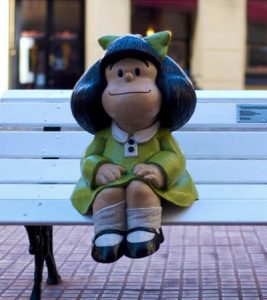
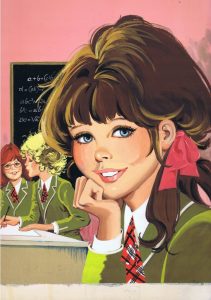
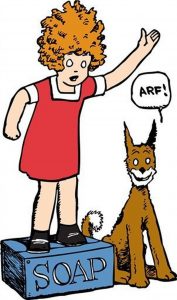
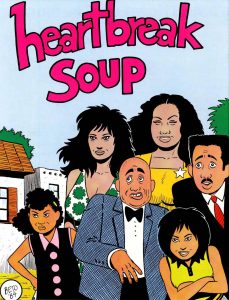
Be sure to stay tuned until the end, when Dr. Jiménez Varea discusses a bunch of interesting girls in comics:
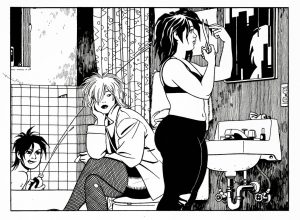
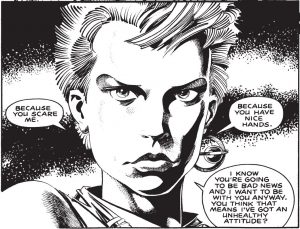
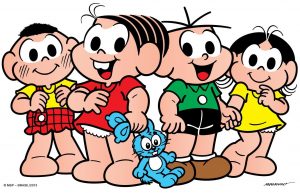
Mafalda (Quino – Argentina), Esther (Purita Campos – Spain), Little Orphan Annie (Harold Gray – USA), Palomar (Gilbert ‘Beto’ Hernández – USA), Locas (Jaime Hernández – USA), The Ballad of Halo Jones (Alan Moore & Ian Gibson – USA), Monica’s Gang – Turma da Mônica (Mauricio de Sousa – Brazil)
#MoonLanding50
Almost 50 years after the first landing on the moon, my favourite girl on the moon: Antonio Rubino's Viperetta, il mio sbarco sulla Luna prediletto #MoonLanding50 #COMICSUGent pic.twitter.com/KKHnK0J9kw
— Eva Van de Wiele (@Eva_vdw) July 19, 2019
Queering Comics
Great workshop on Queering Comics by Dona Pursall #COMICSUGent @childrensliteraturesummerschool @UAntwerpen pic.twitter.com/rFNmtKFyC5
— Eva Van de Wiele (@Eva_vdw) 3 de julio de 2019
Plenary lecture on sticky stereotypes
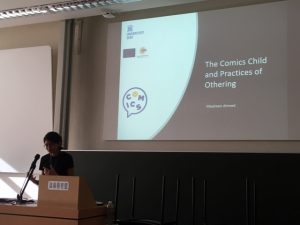
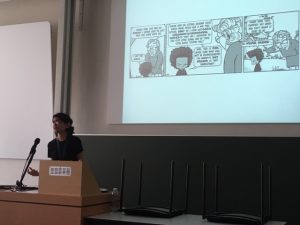
We are at the Summer School on Children’s Literature at the University of Antwerp this week. Maaheen started today with a captivating, fully citational lecture on the practices of othering in comic strips and advertisements.
Abstract Comics by Andrei Molotiu
I'm curious: how do my Twitter friends interpret this? Great workshop by @philnel at @Children'sLiteratureSummerSchool at Antwerp Summer University. pic.twitter.com/R6NEEWaPnb
— Eva Van de Wiele (@Eva_vdw) 1 de julio de 2019
CartoonsFestivalKnokke
Discovered @oleismos at #cartoonfestivalKnokke. Here are some personal highlights, also a great cartoon for #MadridCentralEsSalud by Thiago pic.twitter.com/SFZdeBJDTD
— Eva Van de Wiele (@Eva_vdw) 30 de junio de 2019
II Congreso Internacional de Estudios Interdisciplinares sobre Cómic 15- 16 y 17 de mayo de 2019
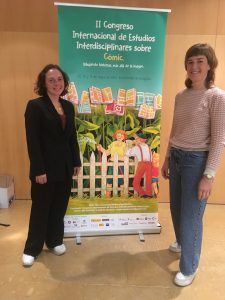
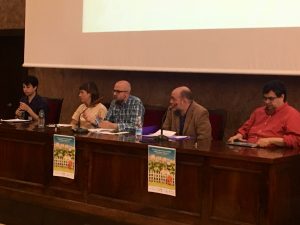
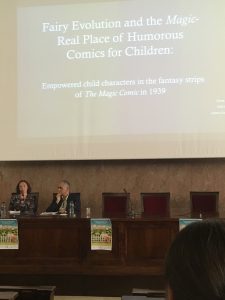
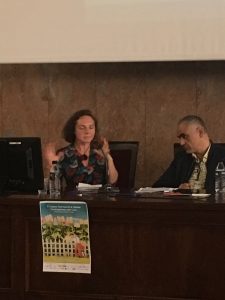
Dona Pursall y yo fuimos al segundo congreso internacional sobre cómic organizado por la universidad de Zaragoza para proponer nuestras comunicaciones. Yo me enfoqué en los usos del motivo narrativo de la metamorfosis en el TBO (1921-1932) y Dona presentó The Magic Comic de finales de los años treinta. Os presentamos un par de fotos. Fue un congreso con mucha cantidad pero también con mucha calidad. Desgraciadamente faltaban algunos de los ponentes más importantes, como la profesora Viviane Alary, miembro de mi tribunal de doctorado, y Antonio Martín, uno de los pioneros, historiadores del cómic español.
Zine happening Gent 11-12 mei 2019
Ook morgen nog zine happening Gent, met @federicabellomi van Materia Degenere, the lovely @g_molist & the delightful Cecilia Valaguzza, thanks @lesvoizinesgent #Stripgids #stripgilde pic.twitter.com/CG6DmmfKfW
— Eva Van de Wiele (@Eva_vdw) 11 de mayo de 2019