New publication on Popular Press in Fascist Italy by dr. Manuela Di Franco

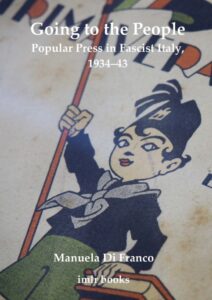
Our colleague dr. Manuela Di Franco has an Open Acces volume out with imlr books: Going to the People – University of London Press

In the interwar years, Italy underwent profound social and cultural transformations which shaped the emergence of a modern mass-consumer society. Amidst the Fascist regime’s centralised control over cultural production, new forms of popular print culture flourished, most notably the rotocalco, the illustrated magazine aimed at a broad readership. This book explores the development and popularity of these magazines in the 1930s and early 1940s, focusing on how they navigated the tensions between authoritarian cultural policies and the powerful appeal of foreign models, especially from the USA. Di Franco analyses three representative magazines, investigating the complex dynamics of cultural exchange defining Italian print culture under Fascism, a field caught between commercial imperatives and ideological pressures; and examines how these magazines served as sites of transnational cultural negotiation, blending entertainment, Fascist influence and the demands of an increasingly modern readership. The rotocalco emerges as both a product and a driver of Italy’s evolving mass-media landscape, in which nationalist rhetoric co-existed with international influences and the popular press mirrored society’s contradictions and transformations.

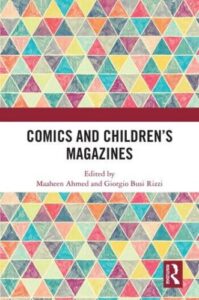
New publication on Comics and Children’s Magazines

New publication, edited by Prof. Maaheen Ahmed and dr. Giorgio Busi Rizzi

Comics and Children’s Magazines | Maaheen Ahmed, Giorgio Busi Rizzi | (scroll down to download 2 chapters)

Comics and serial print have a long, closely intertwined history, with the earliest comics proliferating in newspapers before gradually migrating to children’s magazines. In positioning itself between the booming  research on comics and periodicals and comics and children’s culture, this book offers a transnational perspective on the diverse connections between the ninth art and magazines.

Beginning with the heyday of children’s periodicals and their incorporation of comics since the late nineteenth century in the UK, the book ends with a survey of paratextual reader engagement in Topolino issues until the 2010s. Its eight chapters showcase different possibilities for analysing vast, serial corpora, ranging from thematic and formal approaches to more distant readings mapping evolutions across magazine issues. It covers the impact of American comics on the Corriere dei Piccoli magazines from the 1920s and 1930s, forms of editorial communication in French and Belgian magazines from the 1930s and 1940s, the interplay of artistic pursuit, commercial needs, and national identity in the American Camera Comics from the mid-1940s, the comics scare in Italy read through the Italian Western comic Pecos Bill, the changing editorial policies of French magazine Lisette, and the construction of post-war national identity in Greek comics.

This book will be of great interest to comic and children’s literature enthusiasts along with researchers of comic studies, cultural studies, literature and art. The chapters in this book were originally published as a special issue in the Journal of Graphic Novels and Comics.


Table of contents

Introduction: Comics and Children’s Magazines
Maaheen Ahmed and Giorgio Busi Rizzi

Stories and Pictures for Boys and Girls: Identifying the Child Reader in British Comics 1890-1920
Michael Connerty

Domesticating American Serial Characters in European Children’s Comics Magazines: The Case of Corriere dei Piccoli in the 1910s
Eva Van de Wiele

Editorial Communication: Letter Columns in the French-language (Comics) Magazines (1934-1949)
Maaheen Ahmed

Cameras and young people belong together: Camera Comics (1944-46) as an imaginative, ideological and commercial space for addressing and depicting American child photographers
Annebella Pollen

Pecos Bill and the Campaign against Children’s Comics in Postwar Italy
Paola Bonifazio

Lisette and the disappearance of illustrés for girls
Nicolas Labarre

1953-1970. Stories of Young Orphans in the Service of National Reconciliation
Effie Amilitou and Mikros Iros

“Topolino” beyond comics: fostering readership engagement and parasocial relationship through the paratextual apparatus (1960–2010)
Benedetta D’Incau
 

Webinars on comics and graphic novels in language education

Comics and Graphic Novels in the Language Class in Secondary Education – Ghent Uni Societal Value Fund

From January 2025 until December 2025 Eva Van de Wiele is working on a side project, inspiring teachers to use comics in language education.

Since 2017 the Netherlands has a “Graphic Novels voor de Leeslijst” , a selection of “literary comics” with which Margreet de Heer hoped to inspire teachers and pupils. The pedagogical advantages of comics in language education have been promoted by scholars (Amann & Walner 2022) and teachers. Lesson plans made by teachers for teachers focus on making comics or on approaching the literary aspects of graphic novels (Klascement). Still, comics appear in a plethora of formats and materials (zines, webcomics) and reach their diverse publics through diverse distribution channels. To help language teachers with a background in literary and linguistic studies, this project develops workshops and a webinar on comics as a medium, with attention for multimodality, publication format and implied audience. The corpus will provide teachers with a multilingual corpus (Dutch, French, German, English, Italian, Spanish).

Enroll for Eva’s workshops ->Strips en beeldromans in de taalles | Humanities Academie

Watch the webinars for inspiration


Thanks to Ghent University BOF fund for financing this project!

Thanks to Robbe Wulgaert for helping record and finetune the webinars!

Strips in de taalles en rondleiding in de Van Passen collectie


Ben je taaldocent in het secundair onderwijs? Dan ben je misschien geïnteresseerd in onze volgende activiteiten op 30 april en 23 oktober 2025:

Deze studievoormiddag combineert een workshop over strips in de taalles met een rondleiding in de uitgebreide stripcollectie van de Faculteitsbibliotheek.

In anderhalf uur behandelt dr. Eva Van de Wiele in een workshop hoe je strips en graphic novels in de taalles kan gebruiken. Aan de hand van verschillende strips in verschillende formaten en verschillende talen, proberen we elke taaldocent inspiratie te bieden. Je leert ook de belangrijkste vaktermen en hoe je die in jouw doeltaal kan doorgeven aan je leerlingen.

Prof. Maaheen Ahmed neemt je aansluitend mee door de boeiende en uitgebreide Van Passen collectie van de UGent.

Inschrijven 

New publications about the COMICS project activities

We are incredibly happy to report two short publications about our project!

First, Sylvain Lesage devotes a nice, insightful article (in French) to From Private to Public, Philippe Capart’s volume dedicated to exploring and contextualizing the Van Passen collection (link to the first episodes here).

Second, Eva Van de Wiele (with contributions from Maaheen Ahmed and Lou Braibant) writes an in-depth review (in Dutch) of the exhibition ISSUE ZERO – Reading the Van Passen Collection, which takes place (and renews it material every two weeks) from September 16 to December 22 this year at KIOSK, Pasteurlaan 2 in Ghent (clicking on this link one may download the biweekly ‘issues’ that accompany the exhibition).

The Cambridge Companion to Comics

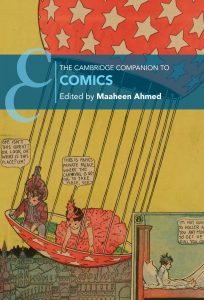
The Cambridge Companion to Comics is out!


With original and insightful chapters by Simon Grennan, Paul Williams, Matthieu Letourneux, Jaqueline Berndt, Giorgio Busi Rizzi, Blair Davis, Jan Baetens, Daniel Stein, Nicolas Labarre, Shiamin Kwa, Erwin Dejasse, Benoît Crucifix, Kim Munson, Mel Gibson, Susan Kirtley and Joe Sutliff Sanders.


To find out more, read the blogpost on Fifteen Eighty-Four:

https://www.cambridgeblog.org/2023/06/so-you-think-you-knew-comics/


Or listen to the History of Literature podcast:


Or listen to the New Books in Literary Studies episode for the New Books Network:

https://newbooksnetwork.com/the-cambridge-companion-to-comics


A new article on the Van Passen collection!

Prof. Hugo Frey, affiliated member of the COMICS team, has recently discussed the Van Passen collection in a new entry of Paper Trails, the BOOC (living online book) edited by University College London Press and dedicated to “The Social Life of Archives and Collections”.

Prof. Frey detailed the acquisition and curation of Alain Van Passen’s “enormous personal collection of predominantly, but not exclusively, Francophone comics” by Prof. Ahmed, and explore its holdings, now “preserved in over 700 box files” and comprising “comics from much of the twentieth century, with some core emphasis on the long period of 1940–80”, making it, in Prof Frey’s words, “one of the key sites of comics research for twenty-first-century scholarship”.

You can read the whole article here: https://ucldigitalpress.co.uk/BOOC/Article/3/125/ .