/ Bandes dessinées hors-champs
3-4 juin 2021, Université libre de Bruxelles
In his doctoral dissertation La Bande dessinée et son double, Jean-Christophe Menu puts forward the notion of a “corpus hors-champ de la bande dessinée” to describe “an entire corpus of works that undoubtedly belong to the field [of comics] but is not integrated into its History, and hence is not recognized as an integral part of the field” (2011, 432). This conference aims at seizing this complex and hard-to-translate notion of the corpus hors-champ, locating an ‘outside’ of comics. Beyond its specific use in Menu’s theoretical discourse, this notion can facilitate the convergence of various research interests to bring forward objects for scrutiny that were held at the margins of comics studies.
Expanding a corpus
The ‘outside’ invites us to expand our usual corpora to a wider range of objects, works, and practices positioned at the limits and margins of what has been established as ‘field.’ While the effects of demarcation, hierarchization and legitimization linked to the “constitution of the comic strip field” (Boltanski 1975) have been quite clear, its constitution has also been nuanced (Maigret 1994) and the unity of the field itself is not necessarily self-evident. Rather than trying in vain to redefine the parameters of the field, this symposium invites a broad and changing understanding of the ‘field’, where its ‘inside’ (champ) and ‘outside’ (hors-champ) are caught in a dynamic tension. For all its spatial connotations, the ‘field’ appears as a moving target: a work, a practice, an object can slide from center to periphery and vice versa. The chosen focus and approach, together with the methods applied for analysis, fully participate in the construction of this corpus hors-champ.
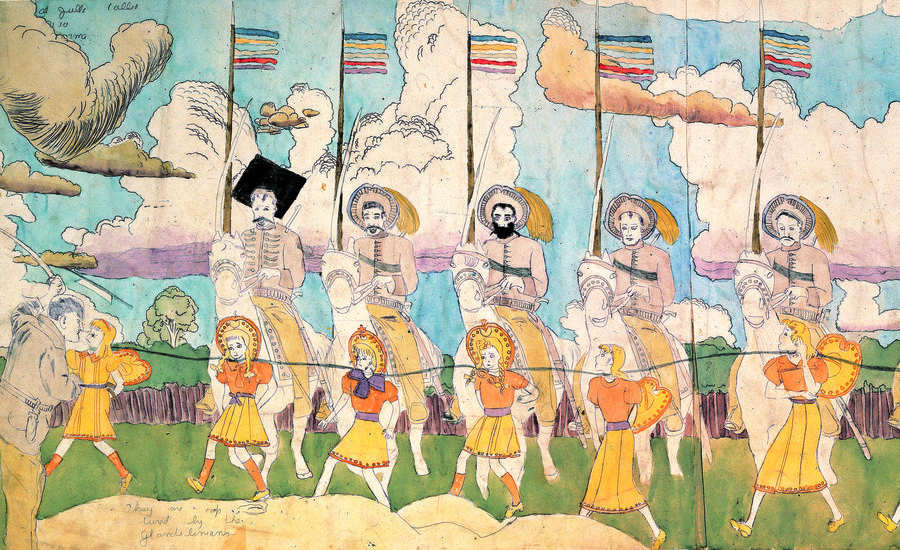
Following in the tracks opened by Jean-Christophe Menu, comics on the outside could include unpublished works, produced in an intimate or private sphere or distributed through underground channels. The “mutual kinship” between outsider art and comics (Dejasse 2020) provides a point of departure for such an inquiry. This kinship emphasizes production contexts and creator profiles at the margins of common professional and social trajectories. It can also circumscribe affinities with graphic productions that privilege ‘unstudied drawing,’ made without training or through a process of un-training or “deskilling” (Roberts 2010). Such kinship can also be extended to children’s drawings, such as those that Lynda Barry (2014;2019) “saves from the trash” to compose her how-to-cartoon manuals. Stick figures, doodles, and graffiti are moreover repeatedly invoked in Rodolphe Töpffer’s theoretical considerations, of which Thierry Smolderen (2009) has shown the relevance for the longer history of comics. Child productions, scribbled albums, marginalia and doodles, teen zines extend the pleasures of comics reading through appropriation and prolongation but have remained largely invisible in comics studies because of the difficulties they generate as objects of inquiry, especially regarding access and methodologies.
Comics can also be found in circulation networks and distribution channels outside its main cultural industries, where they inhabit a modest and discreet, peripheral position: professional magazines, information bulletins, church tracts, music album covers, political pamphlets, queer and feminist zines, posters and print ephemera. We could also think of comics that remain as “orphan works,” an ambivalent legal status given to works whose copyright owners are unknown. Other practices, finally, thrive through their outsider position: pirate publishing, counterfeit, plagiarism, and such extralegal enterprises moreover use to their advantage their situation in particular geographic or legal zones. The typology elaborated by Tanguy Habrand (2016) to describe a variety of publishing practices outside the traditional publishers’ market can be a helpful inspiration to describe and qualify the specific gestures and techniques, settings and contexts of such initiatives.
Retrospective Additions
Besides identifying new works, objects and practices usually located on the outside of the comics field, we should also consider their annexation, recuperation or integration, processes that unfold over time and distance. One of the objectives of this symposium is to trace the processes through which comics on the outside are moved, displaced, reframed, centered or sent back to the margins. Those movements in and out of the field raise important questions of methods, confronting us with our own disciplinary assumptions.
From a historiographic perspective, Sylvain Lesage has shown the extent to which the album and the construction of comics as “ninth art” has had the effect of sending to the “cultural inferno” a range of productions that were nevertheless at the heart of its cultural life, such as “comics for girls, horror pocket books, ‘drawn novels’, daily strips” (Lesage 2019, 419). If retracing the processes of legitimization and canonization can help us understand the construction of a field (Beaty and Woo 2016), approaching the history of comics from the perspectives of those left at its margins can also be a productive way of interrogating our usual definitions as much as highlighting the blind spots of a retrospective look.
The constitution of a corpus hors-champ thus invites an enhanced reflexivity, thinking from particular cases and choosing the right focus and tools to assess its particularity (Becker 2016). The identification of ‘comics on the outside’ and the recontextualization or appropriation of these objects can also raise difficult but important stakes when it comes to ethics, politics, and ideology.
By casting light on works that are never or rarely taken into account in comics studies, we hope to enrich the spectrum of realizations that are susceptible to discussed in the field. However, our hope is also that the singularity of these new, unusual, unknown or forgotten objects—their esthetic, circulatory or authorial specificities— encourage us to reevaluate the methods of analysis, the theoretical frameworks and the disciplinary habits used to study comics. Livio Belloï and Fabrice Leroy have for instance shown how much the work of Pierre La Police appears as a “wrong object,” a kind of “anti-comics” that “nevertheless forces us to double our efforts in terms of conceptual inventiveness” (2018, 214). This conference can thus be taken as an invitation to bring together wrong objects asking us the right questions.
Dans sa thèse de doctorat La Bande dessinée et son double, Jean-Christophe Menu avance l’idée de « corpus hors-champ de la bande dessinée » pour décrire « tout un corpus d’œuvres relevant […] indéniablement de son domaine mais qu’elle [la bande dessinée] n’intègre pas dans son Histoire, et donc qu’elle ne reconnaît pas comme partie intégrante de son champ » (2011, 432). Ce colloque a pour ambition de se saisir de cette notion de « corpus hors-champ ». Celle-ci est apte à catalyser divers intérêts de recherche et à faire émerger de nouveaux objets d’études jusqu’alors tenus en marge des discours sur la bande dessinée.
Elargir un corpus
Le hors-champ invite ainsi à élargir un corpus à une série d’objets, d’œuvres, de pratiques situées aux limites et aux marges de ce qui est établi comme champ. Les effets de démarcation, de hiérarchisation et de légitimation liés à la « constitution du champ de la bande dessiné » (Boltanski 1975) sont apparus d’avantage en « demi-teinte » (Maigret 1994), autant que l’unité du champ ne fait plus nécessairement valeur commune. Plutôt que de s’essayer à de vaines tentatives de redéfinir le périmètre d’un champ, ce colloque invite à une acception large et fluctuante de celui-ci, défini par effet de contraste : le « hors-champ » est ici envisagé dans une tension dynamique avec le « champ », les deux termes s’impliquant mutuellement. Ces catégories sont en effet mouvantes ; une œuvre, une pratique, un objet pouvant glisser du champ vers le hors-champ et inversement. La focale choisie et la méthode d’approche participent pleinement de la construction de ce « corpus hors-champ ».
À la suite des pistes ouvertes par Jean-Christophe Menu, on peut s’interroger sur des œuvres non-publiées, produites dans une sphère de l’intime et du privé ou transmises par des circulations souterraines. Les « sympathies réciproques » entre art brut et bande dessinée (Dejasse 2020) forment un point d’ancrage pour cette réflexion. Ces « sympathies » font saillir des contextes de production et des profils de créateurs et créatrices en marge des constructions socio-professionnelles habituelles. Elles décrivent aussi des rapports d’affinités avec des productions graphiques qui exhibe le « dessin sans filet », hors des apprentissages, ou par le biais d’un désapprentissage, voire d’une forme de « deskilling » (Roberts 2010). Ces sympathies s’étendent également aux dessins d’enfants, comme ceux que Lynda Barry « sauve de la poubelle » pour composer ses manuels (Barry 2014; 2019). Petits bonhommes, gribouillis, et graffitis forment d’ailleurs autant de figures convoquées par Rodolphe Töpffer dans ses réflexions critiques, dont Thierry Smolderen (2009) a étudié les longues ramifications pour l’histoire de la bande dessinée. Les productions enfantines, les albums gribouillés, les dessins de marge, les fanzines adolescents constituent autant d’appropriations ou de prolongations de lectures de bandes dessinées qui restent largement invisibles car peu accessibles.
Se tiennent également hors-champ, des espaces de circulation et de canaux de diffusion où la bande dessinée occupe une place modeste, discrète, périphérique, ne faisant pas le cœur du propos : revues professionnelles, circulaires d’information, bulletins de paroisse, pochettes de disques et cassettes, cahiers politiques, tracts militants ou religieux, fanzines queer et féministes, posters et objets imprimés éphémères. On peut aussi par exemple évoquer ce qu’on pourrait appeler des bandes dessinées orphelines, pour reprendre le statut légal ambivalent attribué à des œuvres dont les ayant-droits ne sont pas identifiables. D’autres pratiques, enfin, ont tout intérêt à habiter un certain dehors : l’édition pirate et clandestine, la contrefaçon, le plagiat – des entreprises qui en outre tirent parti de zones géographiques et juridiques. On pourra ici suivre la typologie de « l’édition hors édition » (Habrand 2016) pour décrire et qualifier les gestes et techniques, lieux et contextes propres à différentes manières de faire en dehors de l’institution éditoriale.
Annexions rétrospectives
À l’identification d’œuvres, d’objets et de pratiques hors-champs peut suivre leur annexion, récupération ou intégration, s’échelonnant sur des temps et des distances plus ou moins longues. Un des objectifs de ce colloque est donc aussi de saisir ces processus par lesquels certaines bandes dessinées « hors-champ » se voient déplacées, recontextualisées, mises au centre ou justement renvoyées à la marge. Ces jeux de passages entre champ et hors-champ soulèvent des questions fondamentales de méthode, qui nous renvoie à nos propres regards disciplinaires.
Dans une perspective historiographique, Sylvain Lesage a montré à quel point l’album et la construction du « neuvième art » ont eu pour effet de renvoyer aux « enfers culturels » une série de productions qui faisaient néanmoins pleine part de son expérience : « illustrés pour filles, pockets d’horreur, “romans dessinés”, bandes quotidiennes » (Lesage 2019, 419). Si retracer les processus de légitimation et de canonisation nous aident à comprendre la construction d’un champ (Beaty & Woo 2016), envisager l’histoire de la bande dessinée par ses laissés pour compte peut aussi être une manière d’interroger nos définitions courantes comme les œillères d’un regard rétrospectif.
Constituer un corpus hors-champ de la bande dessinée invite ainsi à une réflexivité redoublée, l’étude des « cas particuliers » nécessitant de trouver la « bonne focale » (Becker 2016). L’identification de corpus hors-champ et la re-contextualisation de ses objets peuvent également soulever d’importants enjeux éthiques, politiques et idéologiques de ces appropriations.
En mettant en lumière des créations qui ne sont jamais ou rarement prises en compte dans les études dédiées à la bande dessinée, nous ambitionnons certes d’enrichir le spectre des réalisations qui sont susceptibles d’intégrer ces études. Toutefois, notre espoir est aussi que ces objets nouveaux, inhabituels, méconnus ou laissés pour compte invitent par leurs singularités (esthétiques, réseaux de diffusion, statut de l’auteur) à réévaluer les méthodes d’analyses, les points de vue adoptés, les disciplines convoquées pour étudier la bande dessinée. Livio Belloï et Fabrice Leroy ont par exemple montré à quel point l’œuvre de Pierre La Police constitue un « mauvais objet », sorte d’« anti-bande dessinée » qui « oblige pourtant […] à redoubler d’efforts en matière d’inventivité conceptuelle » (2018, 124). Ce colloque, donc, comme invitation à rassembler autant de « mauvais objets » posant de bonnes questions.
Modalités pratiques
Ce colloque invite à l’analyse de cas particuliers et d’exemples parlant, sans restriction géographique ou temporelle et avec un intérêt pour les perspectives comparatistes et intermédiatiques. Les propositions de communications, d’une longueur de 300 mots maximum, seront à envoyées avant le 25 janvier 2021 aux adresses suivantes : erwin.dejasse@ulb.ac.be benoit.crucifix@ugent.be
Practicalities
This symposium invites papers on particular case studies and telling examples, without geographic or temporal restrictions and with a particular interest in comparative and intermedial perspectives. Abstracts (max. 300 words) should be sent before January 25, 2021 to the following e-mail address: erwin.dejasse@ulb.ac.be; benoit.crucifix@ugent.be
Comité organisateur / Organizing committee
Maaheen Ahmed (UGent)
Benoît Crucifix (UGent)
Erwin Dejasse (ULB)
Fabrice Preyat (ULB)
Comité scientifique / Scientific committee
Jan Baetens (KULeuven)
Laurent Gerbier (Université de Tours)
Simon Grennan (University of Chester)
Maud Hagelstein (ULiège)
Sarah Lombardi (Collection d’Art Brut, Lausanne)
Benoît Majerus (Université de Luxembourg)
Jean-Matthieu Méon (Université de Lorraine)
Elizabeth Nijdam (University of British Columbia)
Denis Saint-Amand (Université de Namur)
Greice Schneider (Universidade Federal de Sergipe)
Tadashi Hattori (Konan University, Kobe)
Références / References
Baetens, Jan. 2016. “Composer ‘avec’ la folie : La réinvention du récit dans Après la mort, après la vie d’Adolpho Avril et Olivier Deprez.” Neohelicon 43 (1): 147–58.
Barry, Lynda. 2014. Syllabus: Notes from an Accidental Professor. Montreal: Drawn & Quarterly.
———. 2019. Making Comics. Montreal: Drawn & Quarterly.
Beaty, Bart, and Benjamin Woo. 2016. The Greatest Comic Book of All Time: Symbolic Capital and the Field of American Comic Books. New York: Palgrave Macmillan.
Becker, Howard S. 2016. La bonne focale. De l’utilité des cas particuliers en sciences sociales. Translated by Christine Merllié-Young. Paris: La Découverte.
Belloï, Livio, and Fabrice Leroy. 2018. “Mimer le savoir pour mieux le miner : le pseudo-encyclopédisme de Pierre La Police.” Revue des sciences humaines, no. 330: 123–45.
Boltanski, Luc. 1975. “La constitution du champ de la bande dessinée.” Actes de la recherche en sciences sociales 1 (1): 329–51.
Crucifix, Benoît, and Pedro Moura. 2016. “Bertoyas dans la jungle. Bande dessinée et édition sauvage.” Mémoires du livre 8 (1).
Dejasse, Erwin. 2020. “Art brut et bande dessinée alternative : sympathies réciproques.” Études francophones, no. 32: 94–109.
Habrand, Tanguy. 2016. “L’édition hors édition : vers un modèle dynamique. Pratiques sauvages, parallèles, sécantes et proscrites.” Mémoires du livre 8 (1): 1–53.
Lesage, Sylvain. 2019. L’Effet livre : métamorphoses de la bande dessinée. Tours: Presses Universitaires François-Rabelais.
Maigret, Eric. 1994. “La reconnaissance en demi-teinte de la bande dessinée.” Réseaux 12 (67): 113–40.
Menu, Jean-Christophe. 2011. La bande dessinée et son double: langage et marges de la bande dessinée: perspectives pratiques, théoriques et éditoriales. Paris: L’Association.
Roberts, John. 2010. “Art After Deskilling.” Historical Materialism, no. 18: 77–96.
Smolderen, Thierry. 2009. Naissances de La Bande Dessinée: De William Hogarth à Winsor McCay. Bruxelles: Les Impressions Nouvelles.
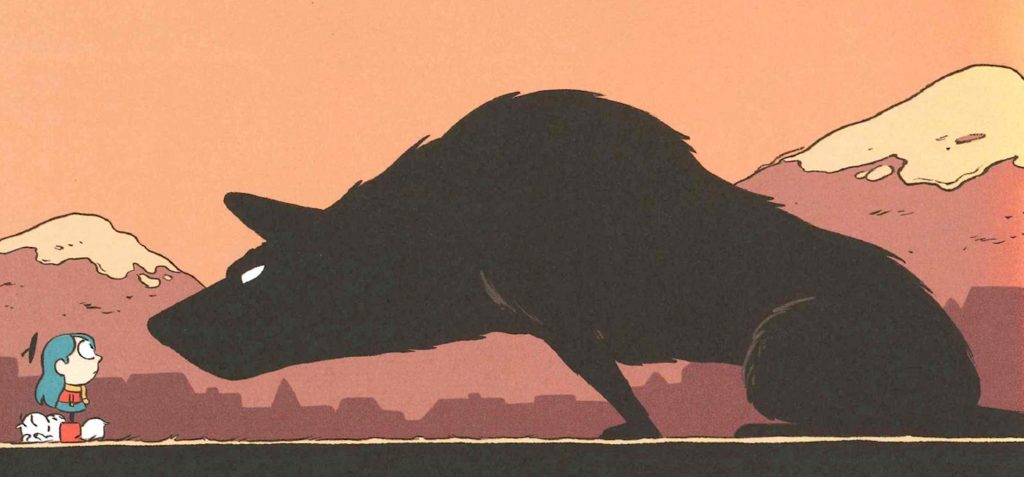
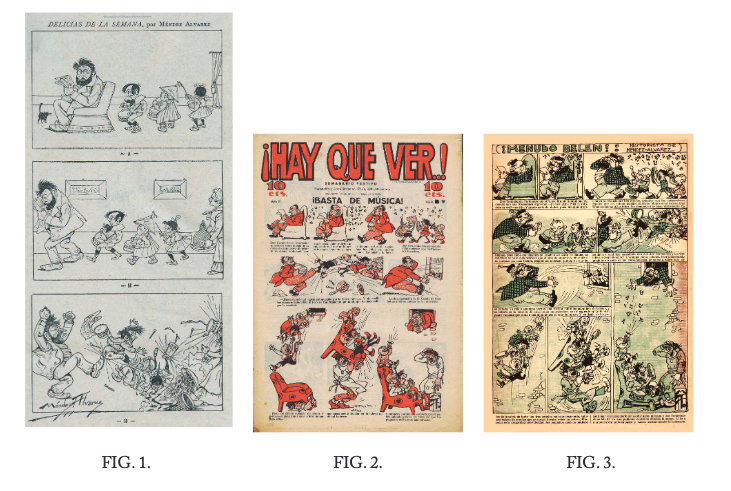
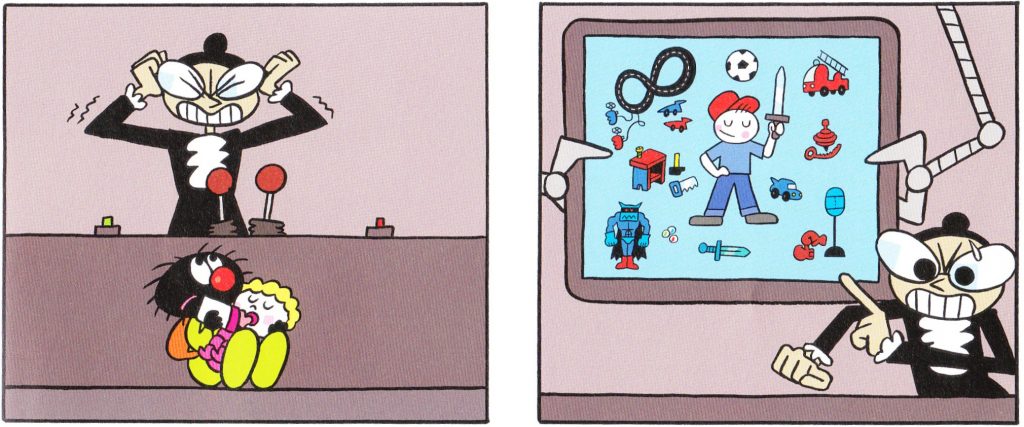
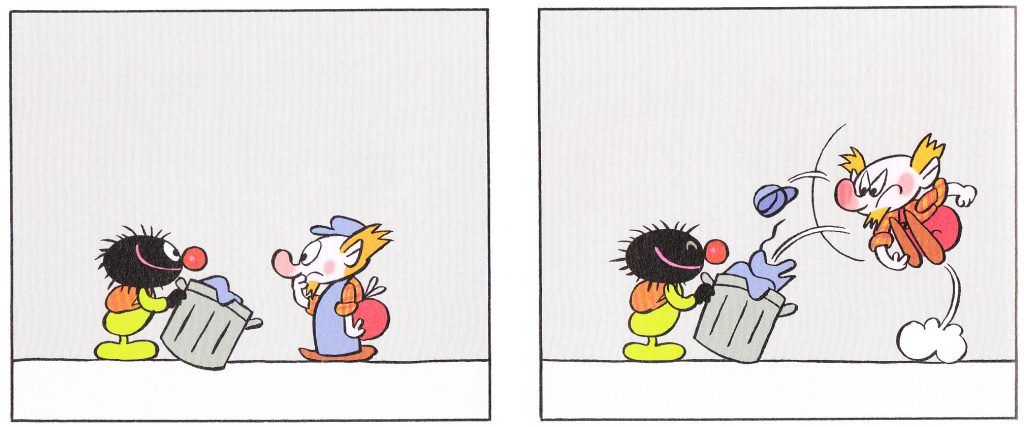
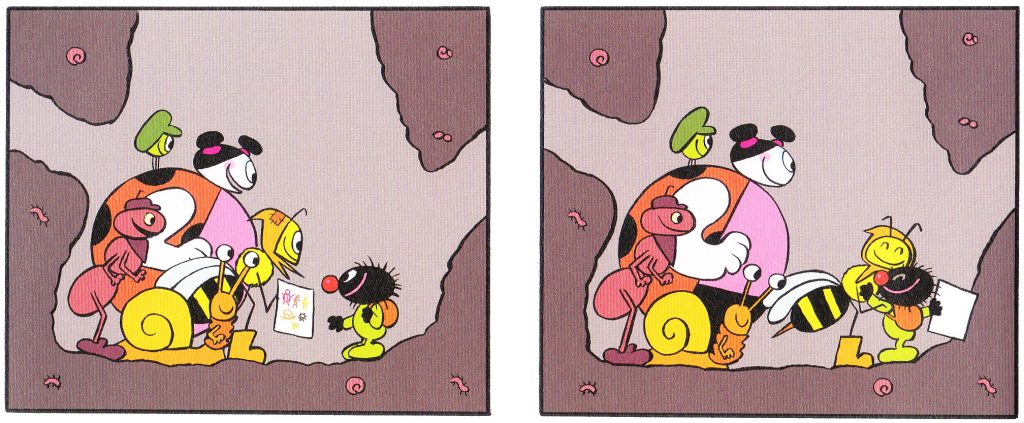
 “Comics have grown up”, we are told time and time again. The increasing visibility of graphic novels, alternative comics and the like confirm this growing up. Their audience has also grown older, in the sense that comic books have long since ceased to be the preserve of children. Growing up also runs parallel to making comics more legitimate although these legitimation activities have also been propelled by nostalgic memories of childhood reading, of comics for (mostly) children. Graphic novels now share shelves with novels, comics have entered museum spaces and original art is sold in galleries. Graphic novels (but not comic strips) now rub shoulders with the classics in reading lists in secondary schools and universities. While these developments are important for introducing comics in general in a broader discourse, comics studies often focus on literary and artistic merits of graphic novels, hence imposing frameworks from the more established arts. In the process, the close connections between children and comics are often overlooked; the less glamorous comics, especially older comic strips and comics magazines by unknown artists and writers, who have not acquired a cult status and have not been reedited and preserved in book form remain ignored, as is still the case with today’s mainstream comics aimed at younger readers. The guiding questions for this column can be spelled out as follows: How to read children across different kinds of comics (strips, magazines, graphic novels)? In particular, what is the significance of child comics characters? And how can we unpack their specificity?